

AI was meant to make work cheaper. Instead, a growing number of companies are receiving bills that even their own managers can no longer tie to any clear benefit. The reason runs deeper than the technology, and it will decide whether AI ever pays off.

Zani is senior speaker and leadership expert.
Before he joined JENEWEIN, he worked in the finance industry.
I believe the biggest surprise of the current AI wave right now is not the technological breakthroughs, but the invoices that many companies are receiving.
Until recently, the expectation was fairly clear. Artificial intelligence was supposed to take over routine tasks, speed up processes and, in doing so, cut costs. Many executives assumed the investment would pay for itself quickly, and that AI would above all help to make human work more efficient or replace parts of it.
By now, though, a far more nuanced picture has emerged. In many companies, spending is rising faster than expected, while the concrete economic benefit is often hard to quantify.
"The question is not only whether AI has potential, but when it actually takes effect, and under what conditions it translates into measurable economic value."
Dr. Zaniyar Sharifi
And then the annual AI budget has run out after four months
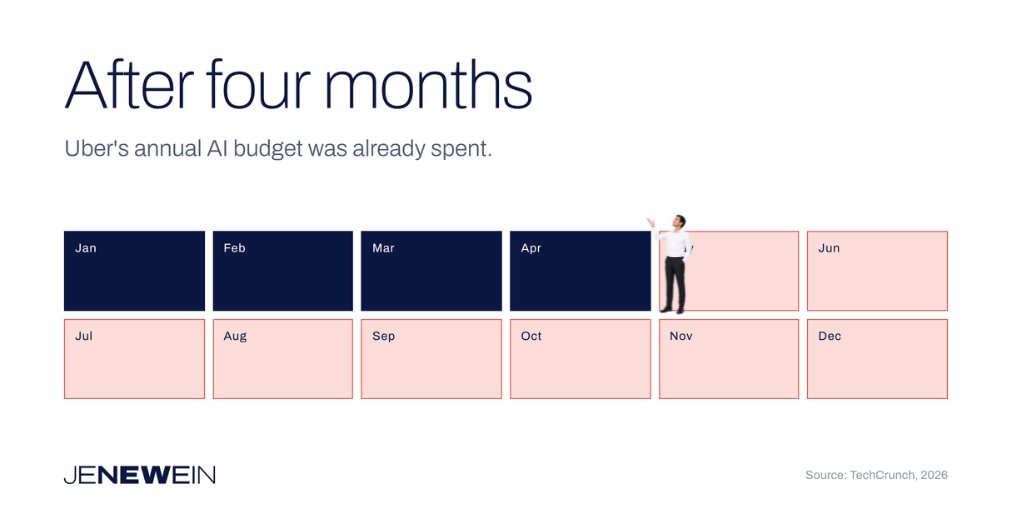
Take Uber. As TechCrunch reports, the company’s AI budget for the whole of 2026 was already exhausted after just four months. One case stands out in particular: a manager whose two-hour programming session, supported by an AI model, is said to have run up costs of around US$1,200. Uber responded by capping spending per employee.
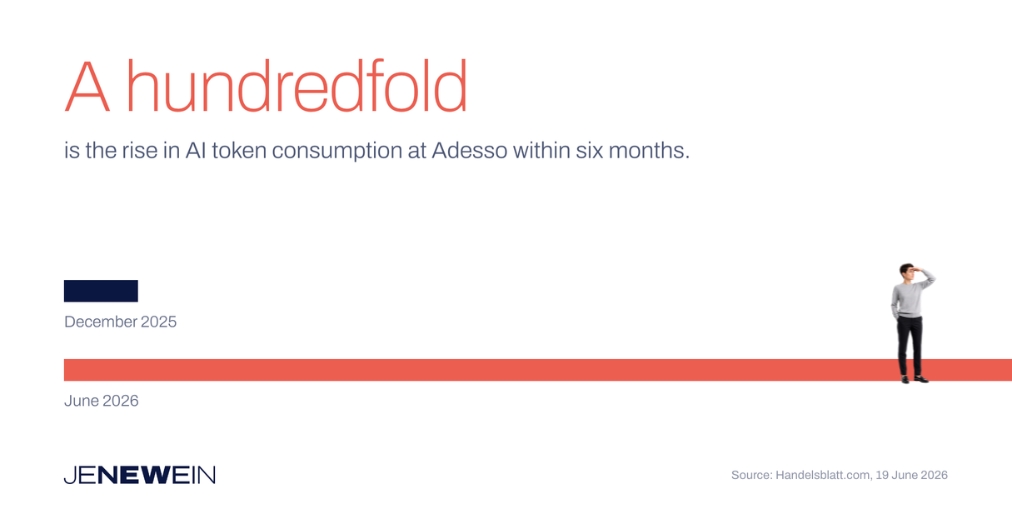
Europe is seeing similar developments. According to Handelsblatt, the Dortmund-based IT company Adesso now spends a six-figure sum on AI applications every month. At the same time, its token consumption has increased a hundredfold since December 2025. Tokens are, put simply, the billing unit of modern language models. The more often and more extensively these systems are used, the higher the running costs.
Why the cost problem won’t solve itself
What is more, the cost problem is unlikely to resolve itself. Gartner does expect the cost of raw computing power to fall significantly by 2030. But the models are also becoming ever more complex. Agentic AI systems work through tasks in several steps, draw on a range of tools and therefore need far more computing power than earlier applications. What becomes cheaper per unit can still end up more expensive overall.
On top of this come the enormous investments in infrastructure. Companies such as Amazon are pouring hundreds of billions of dollars into new data centres, around 200 billion in 2026 alone. These costs have to be recouped over time, and will therefore be reflected in the price of AI services. (Source: https://www.datacenterdynamics.com/en/news/amazon-capex-to-hit-200bn-in-2026-will-mostly-fund-aws-data-centers/)
The central question, then, is no longer simply whether AI has potential. What matters is when that potential actually takes effect, and under what conditions it translates into measurable economic value.
"In the end, the return on AI is decided in the processes, in employees' judgement, and above all in the company's culture."
Dr. Zaniyar Sharifi
Amara’s Law: overestimated in the short run, underestimated in the long run
Amara’s Law helps to make sense of the current situation. The futurist Roy Amara argued as far back as the 1970s that we overestimate the effects of new technologies in the short term and underestimate them in the long term.
We are seeing exactly this pattern with AI today. In the short term, many expected the technology to generate enormous productivity gains very quickly, take over large parts of knowledge work and cut costs immediately. Those expectations were probably too high, and came too early.
In the long term, the potential of AI is nonetheless immense. I am convinced it will fundamentally change our working world, our processes and, in all likelihood, entire business models. The mistake, therefore, is not to believe in this potential. The mistake is to assume that this long-term state has already been reached today.
Many companies now have powerful models, but not yet the processes, skills and structures to use them sensibly. That is precisely where the gap between technological possibility and economic benefit comes from.
When no one knows what the money is being spent on
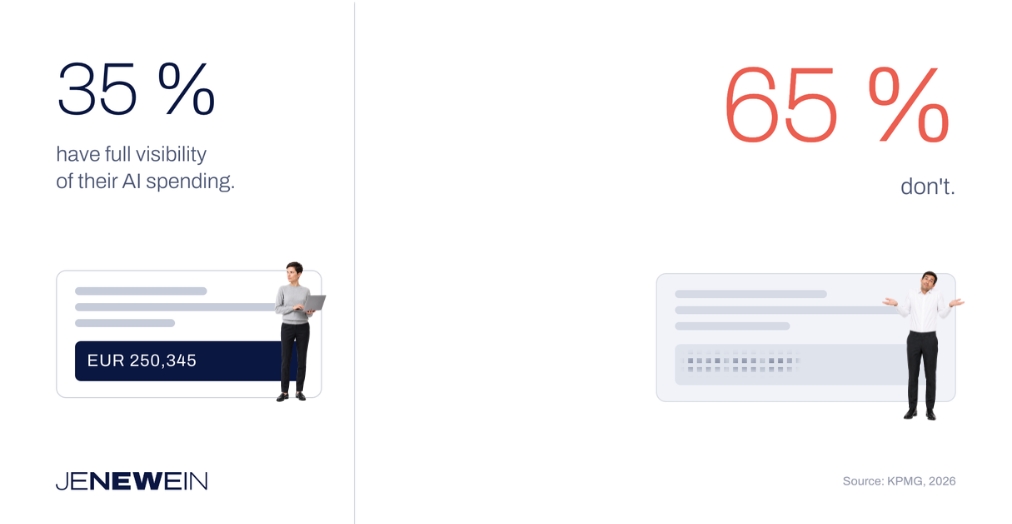
This shows up most clearly in cost transparency. According to an international KPMG study, only 35 per cent of companies have full visibility of how much they actually spend on AI. At the same time, around half of all companies have already scaled back or stopped individual initiatives because the costs exceeded the expected benefit.
The most common response is limits. Budgets are capped, employees are given token allowances, or access to more powerful models is restricted. Such measures can make sense in the short term, because they keep spending under control. But they do not solve the real problem.
Because the decisive question is not how much AI a company uses. What matters is what it is used for, and whether it actually creates value.
When even Uber can’t put a figure on the benefit
A remarkably candid assessment comes from Uber itself. COO Andrew Macdonald said he could not yet establish a link between rising AI spending and a clear benefit for customers. His words were suitably blunt: “That link is not there yet.”
Perhaps that is where the most important insight lies. Technology does not automatically create value. It only delivers its benefit once an organisation knows where it makes sense to use it, and how to integrate it into existing ways of working.
What the Klarna case reveals
Klarna offers a good example. The company replaced around 700 customer-service roles with AI. Later, Klarna began hiring people again. CEO Sebastian Siemiatkowski admitted self-critically: “We went too far.” The systems did work faster, but at the same time the quality of the answers declined and customer satisfaction suffered.
This example shows that AI does not simply replace people. Rather, it changes the way people work. That is precisely why its economic success is not determined by the quality of the models alone, but by how well an organisation integrates those models into its processes, decisions and day-to-day collaboration.
The real gap is a learning gap
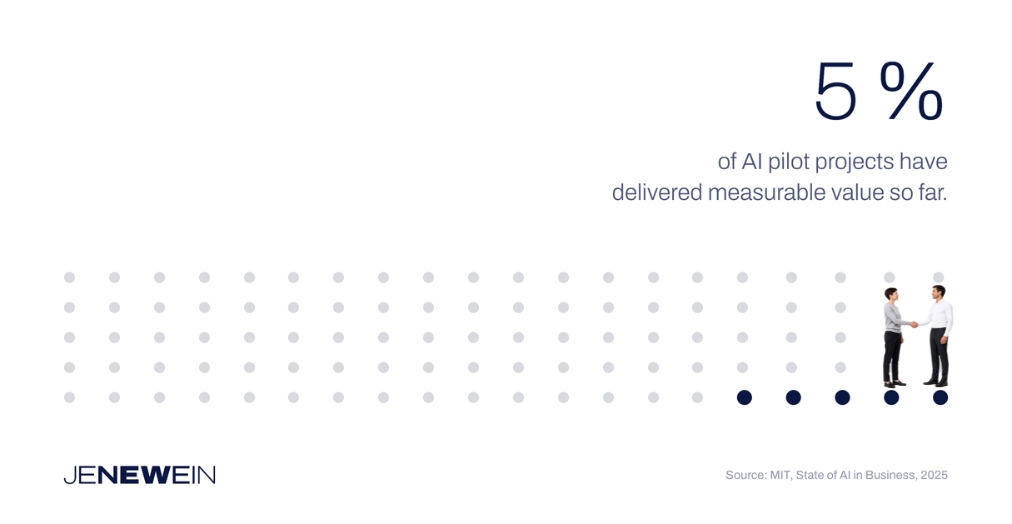
A widely cited MIT study reaches a similar conclusion. It shows that around 95 per cent of all AI pilot projects deliver no measurable return on investment. What is striking, however, is the reason. The researchers do not primarily blame the capability of the models. Instead, they speak of a “learning gap”: a gap between the available technology and an organisation’s ability to use it sensibly.
The few companies where AI already generates clear economic value do not necessarily have better models. Above all, they have a better way of working with those models.
Why culture becomes a business metric
This is exactly where culture becomes a business metric. The first decisive factor is judgement. Not every task needs the most powerful and most expensive model. Employees have to be able to tell when AI creates genuine value and when simpler tools will do. Anyone who manages costs solely through bans and limits is treating the symptom. Anyone who invests in capability changes the quality of use.
The second factor is how a company handles knowledge. Companies that see AI mainly as an instrument for cutting headcount risk losing experience, context and tacit knowledge. This knowledge is often held in no database. It sits in people’s heads, in their relationships, and in their ability to read situations correctly.
The third factor is trust. When employees experience AI primarily as a cost-cutting programme in disguise, uncertainty sets in. People then use the technology defensively, avoid experimenting or protect their own patch. When AI is understood instead as a tool that extends human capabilities, willingness grows to test new applications and to develop one’s own way of working.
A new leadership impulse every Monday
The management task of the coming years
Perhaps that is exactly where the central management task of the coming years lies. It is not about buying as much AI as possible, as quickly as possible. It is about building an organisation that knows where AI makes sense, which capabilities it complements, and where human judgement remains indispensable.
Amara’s Law reminds us to be patient and ambitious at the same time. In the short term, we should take a more realistic view of AI’s impact and not expect every investment to generate productivity straight away. In the long term, however, we must be just as careful not to underestimate its potential.
The decisive question, then, is not whether AI will change our companies. It very probably will. The question is whether our organisations can learn quickly enough to turn technological potential into real economic value.
Because in the end, the return on AI is not decided in the data centre alone. It is decided in the processes, in people’s judgement, and above all in the culture.